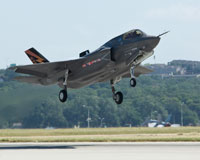
Lightning
II, (formerly the Joint Strike Fighter) was selected to
meet the UK's Joint Combat Aircraft requirement for a
survivable, stealthy, multi-role, all-weather, day and
night, fighter/attack air system, able to operate from
land and sea. Using secure links, the aircraft will
operate as an ISTAR (Intelligence, Surveillance, Target,
Acquisition and Reconnaissance) platform.
Once in
service we would expect the Lightning to be capable
of undertaking air interdiction operations, making low
or medium level attacks using precision-guided, freefall
or retarded bombs. Close air support missions against
targets in the forward edge of the battle area and fleet
air defence patrols in the area of vessels that require
protection from enemy air attack.
Although
the US Company Lockheed Martin is the prime contractor,
the UK is a Level 1 partner with the US Government and a number of
British companies, including BAE Systems and
Rolls-Royce are participating.
These UK companies have had extensive involvement in
building and developing the aircraft. Under current
plans, about 15 per cent of the aircraft will be
manufactured in the UK, securing about 25,000 jobs.
The UK's first three Lightning II aircraft are currently
participating in the US Test and Evaluation programme at
Elgin Airforce Base in the US. Frontline aircraft are
expected to be delivered from 2015 onwards, with an
initial operating capability from land in 2018, followed
by first of class flights from HMS Queen Elizabeth later
that year. In March 2013, the MoD confirmed that RAF
Marham would be the main operating base for Lightning
II.
Decisions on the overall order for Joint Strike Fighters
will not be made until the Strategic Defence and
Security Review in 2015. However, most analysts believe
that there will be an initial UK order for about 50
aircraft. Current cost estimates vary, but there seems
to be a reasonable consensus that around a unit cost of
between £100 - 125 million per aircraft. Current
expectations are that the aircraft will remain in
service until at least 2040.
|
F-35B LIGHTNING II
Specifications
|
| Crew |
1 |
| Max Speed Mach |
1.8 |
| Span
|
10.67m
|
| Length |
15.6m
|
| Weight empty |
14,700kg |
| Max Take off weight
|
27,200kg |
| Combat Radius
(internal fuel) |
860km |
| Range |
1,670km |
| Max Altitude |
50,000ft |
| Armament |
Paveway IV, AMRAAM,
ASRAAM, Brimstone, Storm Shadow |