|
|
|
|

|
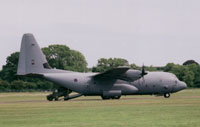
The C-130 Hercules is the workhorse
of the RAF transport fleet. Over the years it has proved to be a
versatile and rugged aircraft, primarily intended for tactical
operations including troop carrying, parachuting, supply
dropping and aeromedical duties.
The Hercules can operate from short unprepared airstrips, but
also possesses the endurance to mount-long range strategic lifts
if required.
The aircraft is a derivative of the C 130E used by the United
States Air Force, but is fitted with British Avionic equipment,
a roller conveyor system for heavy air drops and with more
powerful engines. The crew of five (K version) includes, pilot,
co pilot, navigator, air engineer and air loadmaster.
As a troop carrier, the Hercules can carry 92 fully armed men,
while for airborne operations 64 paratroops can be dispatched in
two simultaneous "sticks" through the fuselage side doors.
Alternatively, 40 paratroops can jump from the rear loading
ramp. As an air ambulance the aircraft can accommodate 74
stretchers. Freight loads that can be parachuted from the
aircraft include. 16 x 1 ton containers or 4 x 8,000 pound
platforms or 2 x 16,000 pound platforms or 1 x platform of
30,000 pounds plus. Amongst the many combinations of military
loads that can be carried in an air landed operation are. 3 x
Ferret scout cars plus 30 passengers or 2 x Land Rovers and 30
passengers or 2 x Gazelle helicopters.
Of the original 66 C1 aircraft, some 31 were given a fuselage
stretch producing the Mark C3. The C3 "stretched version"
provides an additional 37 per cent more cargo space. Refuelling
probes have been fitted above the cockpit of both variants and
some have received radar warning pods under the wing tips. This
is known as the Hercules K and it finally retired from service
in late 2013.
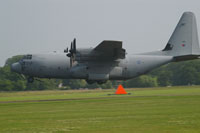
HERCULES C-130J C4/C5
The RAF has replaced some of its
Hercules K C1/C3 aircraft with second-generation C-130Js on a
one-for-one basis. Twenty-five Hercules C4 and C5 aircraft were
ordered in December 1994, and the first entered service in 2000.
Deliveries were completed by 2003 at a total cost of just over
£1bn.The C4 is the same size as the older Hercules C3 which features
a fuselage lengthened by 4.57 m (15ft 0 in) than the original C1.
The Hercules C5 is the new equivalent of the shorter model. With a
flight deck crew of two plus one loadmaster, the C-130J can carry up
to 128 infantry, 92 paratroops, 8 pallets or 95 medical stretchers.
The C4/C5s has Allison turboprop engines, R391 6-bladed composite
propellers and a Full Authority Digital Engine Control (FADEC). This
propulsion system increases take-off thrust by 29 per cent and is 15
per cent more efficient. Consequently, there is no longer a
requirement for the external tanks to be fitted. An entirely revised
'glass' flight deck with head-up displays (HUD) and 4 multi-function
displays (MFD) replaced many of the dials of the original aircraft.
These displays are compatible with night-vision goggles (NVG). MoD
figures suggest that there are 24 C-130J in service.
Latest reports suggest that the C-130J will be retired in 2022.
|
C-130K
HERCULES Specifications
|
| Crew
|
5/6
|
| Capacity
|
92 troops or 64 paratroops or 74 medical
litters
|
| Length
C1
|
29.79m
|
| Length
C3 |
34.69m
|
| Height
|
11.66m
|
| Span
|
40.41m
|
|
Max Speed |
374mph/602kph |
| Empty
Weight |
34,287kg Max |
| Max freight
capacity |
43,399lb/19,685kg |
| All
-up Weight |
45,093kg Max |
| Service Ceiling |
13,075m |
| Engine
|
4 x Allison T-56A-15 turboprops. |
| |
|
|
C-130J HERCULES Specifications
(differences from K version)
|
| Crew |
2 Pilots
and 1 Loadmaster |
| Engines |
Four
Allison AE 2100D3 turboprops |
| Max
Speed |
355kts |
| Range |
3,700nautical miles |
| Max
Altitude |
32,00ft |
| Length |
34.34m |
| Span |
40.38m |
In
service with: (2013)
|
24 Squadron |
6 x Hercules C-130J |
RAF Brize Norton |
|
30 Squadron |
6 x Hercules C-130J |
RAF Brize Norton |
|
47 Squadron |
6 x Hercules C-130J |
RAF Brize Norton |
|
70 Squadron |
6 x Hercules C-130J |
RAF Brize Norton |
Photos Copyright Alasdair Taylor
|