|
|
|
|
|
|
Abbreviations

Armed Forces - RAF Logistics - Summary - Equipment Support (Air) - Defence Logistics Organisation (DLO) - Materiel Supply - Equipment Repair and Maintenence - Defence Communications Services Agency - Defence Aviation Repair Agency (DARA)

SUMMARY

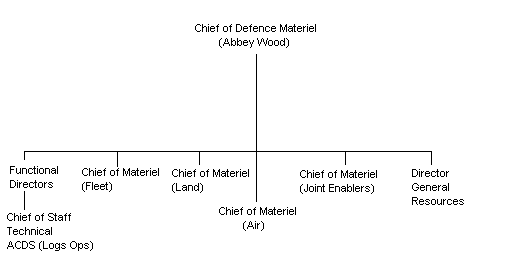
Since the MoD-wide reorganisation of 2000, logistics support for all three Services is the responsibility of Defence Logistics Organisation (DLO). Two DLO Directorates are responsible for logistic provision to the RAF.

  • DG Log (Strike) - 1, 2 & 3 Groups

  • DG Log (Supply Chain) - Commodities Group and Munitions Group

At the MoD, the officer who is ultimately responsible for logistics is the Air Member for Logistics who is one of the eleven Air Force Board Members.

For Strike Command, the Chief-of-Staff Support (COS Support) is the senior Logistics commander and the principal two star officer (Air Vice Marshal) who interfaces directly with the DLO. COS Support has a place on the Strike Command Management Board.

The RAF’s logistics hub has moved from RAF Wyton and was established at RAF Wittering in April 2006. Prior to this 85 (Expeditionary Logistics) Wing (ELW), (including 2 Mechanical Transport Squadron, Mobile Catering Support Unit (MCSU), elements of the Force Development Squadron (FDS) and the Wing Command Group) moved to RAF Wittering from RAF Stafford in September 2005. RAF Stafford is due for closure in December 2007.

RAF Procurement

Like logistics, UK procurement is managed on a tri-service basis by the Defence Procurement Agency (DPA). The DPA was launched on 1 April 1999 as an Executive Agency of the Ministry of Defence (MoD), replacing the MoD Procurement Executive. The core role of the DPA is the procurement of military equipment to meet the operational requirements of the armed forces. RAF operational requirements are formulated and managed by Integrated Project Teams (IPT). RAF personnel are seconded to the DPA for the duration of their appointments – usually two to three years.
 

EQUIPMENT SUPPORT (AIR) - Defence Logistics Organisation (DLO)

The majority of RAF Logistic support is incorporated within the Defence Logistics Organisation under the Equipment Support (Air) business unit. ES (Air) provides in-service logistic support for all Ministry of Defence aircraft and helicopters. It is responsible for the maintenance and support of everything from Chinook helicopters to fast jets such as Tornado, from avionics to ground support equipment. 

ES (Air) manages an extensive inventory of different products and supports over 1,000 aircraft in over 30 fleets. It also contracts out design specifications for new aircraft parts; oversees aircraft modification programmes; provides logistics support for air-launched munitions, avionics and radar systems and works with industry to improve aircraft capabilities. The organisation controls a budget of around £4.3 billion, the majority of which goes to industry for the purchase of spares, repairs and post-design services. ES(Air) manages over 7,000 contracts with some 200 firms – the vast majority of which are British based companies.

ES(Air) is organised into Integrated Project Teams (IPT), which focus on the whole life support of equipment and inventory items used by the Armed Forces, and Directorates, which provide common support services to the IPTs (for example financial services and business improvements). 

As of 2003, ES (Air) is led by DG (Director General) Air Vice-Marshal Peter Liddell. He reports to the Chief of Defence Logistics who sits on the top MoD executive committee - the Defence Management Board as the executive arm of the Defence Council.

ES(Air) workforce of around 4,000 is made up of Army, Royal Navy, Royal Air Force staff and personnel and civil servants. The Headquarters of ES(Air) is located at RAF Wyton and, whilst members of ES(Air) work in over 50 locations, the majority work in nine main sites – Abbey Wood, Brampton, Gosport, Middle Wallop, St Athan, Sherborne, Waddington, Wyton and Yeovilton

MATERIEL SUPPLY

Under the MoD-wide reorganisation of 2000, the DLO became responsible for the centralised storage and supply of RAF materiel through its Defence Supply Chain (DSC) arm. The DSC comprises four agencies whose duties divide into storage and distribution, medical supplies, defence transport and movement and British Forces post.  In addition to these four agencies it also contains six business units, ranging from the Defence Supply Chain Operations to the Defence Catering Corp.  One of these units - Defence Munitions was recently charged with the task of retrieving ammunition from HMS Nottingham.

Operationally, the DLO through ES (Air) also supports major force deployments through PJHQ via a rapid deployment unit based at RAF Stafford. This organisation is equipped to move at very short notice to provide a range of support facilities, including fuel and spares, anywhere in the world.

EQUIPMENT REPAIR & MAINTENANCE - Defence Communications Services Agency

Since the establishment of the DLO, support for the ground-based signals infrastructure is the responsibility of the Air Defence Ground Based Systems Integrated Project Team, dually accountable to the Defence Logistics Organisation and the Defence Procurement Agency, 

This IPT forms part of the Defence Communication Services Agency (DCSA) located at RAF Brampton. The deep maintenance and repair of ground radio and radar equipments is carried out by the Ground Radio Servicing Centre (GRSC) based at RAF Sealand. This includes radars, radio navigation aids and point-to-point and ground-to-air communications. The DCSA provides support to technician training facilities located at RAF Cosford and the Ground Radio Servicing Centre located at RAF Sealand.

The DLO ES (Air) provides an antenna systems maintenance service on a worldwide basis, embracing the fields of communications, radar and navigation aids. The men required for this highly specialised work are trained at the Aerial Erector School at RAF Digby.

EQUIPMENT REPAIR & MAINTENANCE - Defence Aviation Repair Agency (DARA)

Launched on 1 April 1999, the Defence Aviation Repair Agency (DARA) brought together the RAF Maintenance Group Defence Agency (MGDA) and the Naval Aircraft Repair Organisation (NARO). DARA has trading fund status within the MoD, and is not part of the DLO. It will probably be privatised at some stage.

Repair and maintenance activities at DARA are divided into five main groups – fixed-wing aircraft, helicopters, engines, electronics, and components. Scheduled major maintenance, repair, rectifications, reconditioning and modification for a wide variety of aircraft are undertaken for tasks beyond the normal capability of operational stations.
Work on aircraft is carried out at RAF St Athan. 

The DARA engineering unit at St Athan is manned jointly by service personnel and civilians, with an Aircraft Servicing Wing and a General Engineering Wing. In February 2003, DARA announced the construction of a new state of the art £77m facility at the Agency’s headquarters base in St Athan. 

The new repair and maintenance facility will be constructed within a 100-acre site on the existing RAF St Athan base. It consolidates DARA interests and replaces the present facilities, currently spread around the 1000-acre site. The new facility will have the capacity to house 48 jet aircraft, and will be capable of adapting capacity to suit the needs of customers. 

The DARA facility at RAF Sealand near Chester is the main engineering unit for airborne electronic and instrument equipment. Large workshops and test facilities are laid out on production lines to enable the unit to service more than 100,000 items of airborne radio, radar, electrical, instrument and missile engineering equipment per year. The unit also provides a test equipment calibration service and manufactures test equipment, aircraft cables and looms.