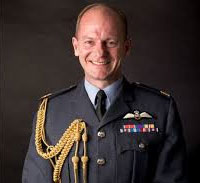
CHIEF OF THE AIR STAFF
Air Chief Marshal Sir Mike Wigston was appointed Chief of the Air Staff on 26
July 2019.
Commissioned on a University Cadetship in 1986, he completed his pilot training
on the Tornado GR1 in 1992 followed by a succession of frontline tours,
including operational deployments enforcing the no-fly zones in Iraq. He
commanded 12(Bomber) Squadron, flying the Tornado GR4 and leading the Squadron
on two operational tours in Iraq and large force exercises in Canada, Malaysia
and the USA. Appointments in operational headquarters have included Al Udeid
Airbase, Qatar, as the Chief of Combat Operations in the Combined Air and Space
Operations Centre; Basrah International Airport, Iraq as Commander 903
Expeditionary Air Wing; and one year in Afghanistan as the Director Air
Operations in Headquarters ISAF Joint Command. He was appointed CBE in 2013 for
his contribution to that mission.
Staff appointments in the Ministry of Defence have included the Operations
Directorate and the predecessor to what is now Military Strategic Effects. In
2013, after a short spell as the Tornado Force Commander, he became the
Principal Staff Officer to the Chief of Defence Staff. In January 2015, he was
appointed Administrator of the Sovereign Base Areas of Akrotiri and Dhekelia and
Commander British Forces Cyprus, responsible for the civil governance of the
Sovereign Base Areas and command of British forces based permanently in Cyprus.
Senior Royal Air Force appointments have included Assistant Chief of the Air
Staff, responsible for the strategic coherence and coordination of the Royal Air
Force, and oversight of the RAF100 centenary programme. Prior to becoming Chief
of the Air Staff, he was Deputy Commander Capability, responsible for the
strategic planning and delivery of all aspects of Royal Air Force capability
including people, equipment, infrastructure and training.
Education and training includes: reading Engineering Science at Oriel College,
Oxford; the Advanced Command and Staff Course; an MA in Defence Studies from
King’s College London; the Higher Command and Staff Course; and the UK Pinnacle
Course. He is a Vice Patron of the Royal Air Force Charitable Trust and
President of the Royal Air Force Rowing Association.
In October 2020, he was appointed to the Military Division of the Most
Honourable Order of the Bath as Knight Commander (KCB).

The Ministry of Defence (MoD) is a Department
of State, headed by the Secretary of State for Defence (SofS) who
implements national defence policy and plans the expenditure of the
defence budget. The MoD is the highest level of headquarters for the
Armed Forces, both administrative and operational. All major issues of
policy are referred to the SofS or to one of his Ministerial colleagues:
Minister of State for the Armed Forces
Minister of State for Defence Personnel, Welfare and Veterans
Parliamentary Under Secretary of State for Defence Equipment, Support
and Technology
Parliamentary Under Secretary of State for International Security
Strategy
Under Secretary of State and the House of Lords Spokesman for Defence
Under the direction of the Defence Council
management of Armed Forces is the responsibility of the Service Boards,
in the case of the Royal Air Force the Air Force Board is the senior
management directorate.
Air Force Board
The routine management of the Royal Air Force is the responsibility of
the Air Force Board, the composition of which is as follows:
The Secretary of State for Defence
Minister of State for the Armed Forces
Minister of State for Defence Personnel, Welfare and Veterans
Parliamentary Under Secretary of State for Defence Equipment, Support
and Technology
Parliamentary Under Secretary of State for International Security
Strategy
Under Secretary of State and House of Lords Spokesman for Defence
Permanent Under Secretary
Chief of the Air Staff
Deputy Commander Operations
Deputy Commander Capability & Personnel
Chief of Materiel (Air)
Assistant Chief of the Air Staff
Specialist officers as required
Air Force Board Standing Committee (AFBSC)
Attended by senior RAF commanders, the AFBSC dictates the policy
required for the Royal Air Force to function efficiently and meet the
aims required by the Defence Council and government. The Chief of the
Air Staff is the chairman of the Air Force Board Standing Committee.
Decisions made by the Defence Council or the Air Force Board are
implemented by the air staff at various headquarters world wide. The
Chief of the Air Staff is the officer ultimately responsible for the
Royal Air Force's contribution to the national defence effort. He
maintains control through the AOC (Air Officer Commanding), and the
staff branches of the various Royal Air Force Headquarters.