|
One of Air Command's major responsibilities is the UK Air Surveillance and
Control System (ASACS). Air Command is tasked with providing early
warning of air attack against the UK air defence region; to provide
fighter and missile defences and the associated ground control system;
fighter co ordination with Royal Naval ships operating in adjacent
waters and to maintain the integrity of UK air space in war.
ASACS comprises a number of individual static and mobile units that
provide the minute-to-minute information on air activity required to
defend the UK and NATO partners. Manned by officers of Fighter Control
under the Operations Support Branch with the support of airmen Aerospace
Systems Operators, ASACS is a computer-based system which gathers and
disseminates information on all aircraft flying in and around the UK Air
Defence Region. The information within is used by the Air Defence
Commander when deciding whether to investigate or perhaps even destroy
an aircraft flying in an area without permission. Information comes from
the RAF's ground-based radars and from the air defence systems of
neighbouring NATO partners. ASACS can also receive information via
digital data-links from other ground, air or sea-based units.
NATO Control and Reporting Centres (CRC) provide state-of-the-art air
defence radar cover across the NATO region. Each CRC has geographical
areas of responsibility and within their own areas, the CRCs receive and
process information provided round-the-clock by military and civilian
radars. In addition to this radar data, the CRCs also exchange
information using digital data-links with neighbouring NATO partners,
AEW aircraft and ships.
The UK CRCs are supported by a number of Reporting Posts/Remote Radar
Heads across the UK that are the locations of the major RAF Air Defence
radars. These radars feed information into the overall UK ASACS (and the
NATO NADGE/Aegis) architecture. In addition to the radars, units have
varying capabilities for the exchange of data-link information and
radars operate around the clock.
ASACS Command and
Reporting Units
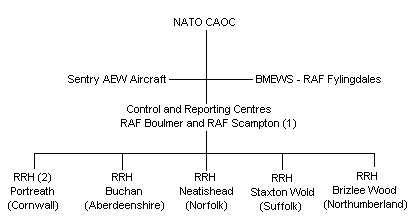
Note:
(1) The CRC at RAF Scampton is an integral part of No1 Air Control
Centre
(2) RRH – Remote Radar Head
During 2008 the MoD confirmed the retention of RAF Boulmer as the ASACS
Headquarters with No.1 Air Control Centre (1 ACC) at RAF Scampton.
In the Falkland Islands there are Reporting Posts at Mount Kent, Mount
Alice and Byron Heights.
Air Defence Aircraft
The second ASACS function is the control of air defence aircraft.
Fighter Controllers provide the tactical control required for air
defence aircraft to police the UK's airspace in peace and war, and they
are also involved in the peacetime training of the RAF air defence
assets. Fighter Controllers also provide support to ground attack forces
when undertaking training with their air defence counterparts.
Quick Reaction Alert (QRA) aircraft are held at immediate readiness for
24 hours a day and investigate all unidentified intrusions into UK
airspace. RAF Coningsby provides the Typhoon aircraft for the QRA
(South) and the QRA (North) is provided for by Typhoon aircraft from RAF
Lossiemouth.
NATO Combined Air Operations Centre
To identify unknown aircraft in the NATO Air Policing Area, the NATO
Combined Air Operations Centre at Finderup in Denmark issues direction
to United Kingdom Control and Reporting Centres for the launch of RAF (QRA)
aircraft. There are about 20 RAF/UK personnel stationed at CAOC Finderup.
The CAOC at Finderup is responsible for the overall coordination of the
Air Defence, Ground Attack and Maritime Air elements of the NATO Region
together with the response of the air forces and navies of our NATO
partners. Within the NATO CAOCs (seven in total across the NATO area),
control and reporting centres are linked with other elements of the NATO
Air Defence Ground Environment (NADGE) and with the Ballistic Missile
Early Warning Systems (BMEWS) station at RAF Fylingdales in North
Yorkshire. The latter is networked with the US operated BMEWS at Thule
(Greenland) and Clear (Alaska). By extending high level radar cover some
3,000 miles across Eastern Europe, Fylingdales provides advance warning
of intermediate range ballistic missiles launched against the UK and
Western Europe and of inter continental ballistic missiles against the
North American continent. Fylingdales also tracks satellites and space
debris.
No 1 Air Control Centre (1 ACC)
1 ACC at RAF Scampton provides the RAF with a mobile command and control
capability able to deploy within the UK or anywhere in the world at
short notice. The unit has recently been transformed into a fully
capable Tactical Air Command and Control System (TACCS) following
delivery of state-of-the-art communications and data-link equipment to
supplement the two new mobile radars recently delivered into its
inventory.
Sentry AEW
The Sentry AEW1 makes a large contribution to ASACS using digital
datalinks. The Sentry can deploy rapidly in response to crisis or
conflict to provide Air Defence Commander with information on potential
aggressors. The roles within the Mission Crew of the Sentry mirror those
within the UK ASACS CRCs, the posts being filled again with Fighter
Controllers and Aerospace Systems Operators.
|




