|
NO 22
(TRAINING) GROUP
No 22 (Training Group) from its
Headquarters at High Wycombe recruits RAF personnel, provides initial
and through career training for RAF personnel and provides other
specialist training to members of the Army and Royal Navy.
The Group operates over 300 training aircraft and has a staff of about
7,000 personnel who work out of eight major UK sites.
No 22 Group provides training as follows:
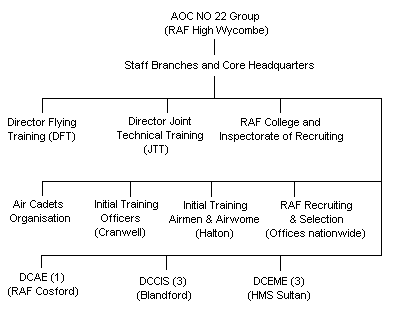
Notes: (1) DCAE – Defence College of
Aeronautical Engineering with HQ at RAF Cosford and operating from other
tri-service sites.
(2) DCCIS – Defence
College of Communications and Information Systems with HQ at the
Blandford (Royal School of Signals) and operating from other tri-service
sites.
(3) DCEME – Defence
College of Electro and Mechanical Engineering Communications and
Information Systems with HQ at HMS Sultan and operating from other
tri-service sites.
No 22 Group provides the following services:
-
Recruiting and selection
of individuals wishing to join the Royal Air Force
-
Provision of Initial
Officer Training (IOT) at the RAF College Cranwell
-
Provision of Basic
Training (BT) for airmen/airwomen at RAF Halton
-
Provision of tri-service
flying training for all types of aircraft
-
Provision of tri-service
aeronautical engineering training
-
Provision of tri-service
communications and information systems (CIS) training
-
Operating the The Red
Arrows (The Royal Air Force Acrobatic Team) from RAF Scampton
-
Responsibility for the Air
Cadet Organisation
-
Responsibility for the 14
x University Air Squadrons
| RAF
Flying Training Squadrons (as of mid 2013) (Aircraft Numbers are our
estimates) |
| 4 (R) Sqn |
16 x Hawk T2 |
RAF Valley (4 FTS) |
| 16 (R) Sqn |
Tutor T1 |
RAF Cranwell (1 EFTS) |
| 45 (R) Sqn |
8 x Beech King Air |
RAF Cranwell (3 FTS) |
| 57 (R) Sqn |
Tutor T1 |
RAF Cranwell (3FTS) |
| 60 (R) Sqn |
Griffin HT1, Bell
412 |
RAF Shawbury |
| 72 (R) Sqn |
Tucano T1 |
RAF Linton-on-Ouse |
| 208 (R) Sqn |
12 x Hawk T2 |
RAF Valley (4 FTS) |
| Central Flying
School |
Various |
RAF Cranwell |

FLYING TRAINING OVERVIEW
Flying training is carried out at the following locations:
RAF Cranwell
Elementary Flying Training HQ
Central Flying School HQ
No 3 Flying Training School
Joint Elementary Flying Training School
Fast Jet Navigation Training
RAF Linton on Ouse
No 1 Flying Training School
Basic Fast Jet Training
RAF Valley
No 4 Flying Training School
Advanced Fast Jet Training
Search and Rescue Training Unit
RAF Scampton
Royal Air Force Aerobatic Team (RAFAT)
RAF Shawbury
Central Flying School Helicopter Squadron
Defence Helicopter Flying School (joint Service)
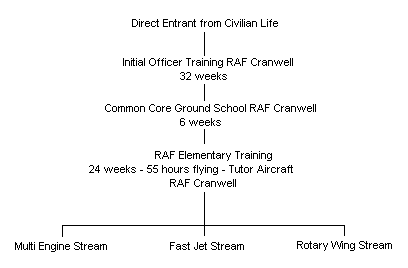
ELEMENTARY FLYING
TRAINING FLOW CHART (DIRECT ENTRANT)
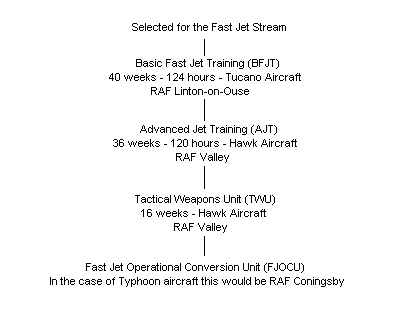
FLYING TRAINING
PROGRESSION EXAMPLE (FAST JET CANDIDATE)
The most recent figures for the average flying hours per month per fast jet
pilot on an operational Typhoon operational squadrons is 17.5 hours.
Recent UK MoD figures suggest that putting a pilot through the flying
training programme (up to the OCU) costs £3.2 million per pilot for fast
jet aircraft, about £600,000 per pilot for multi-engine aircraft and
about £800,000 per pilot for helicopters. These are all inclusive cost
estimates that include all expenses relating to aircraft, instructors,
simulators, airfield support etc.
Fast jet pilots are considered combat ready following Operational
Conversion Unit (OCU) training and a period of post OCU training on an
allocated squadron. Some figures suggest that the cost of training a
Typhoon pilot at the OCU is in the region of £9 million, putting the
total cost of Typhoon pilot training at around £12 million.
During FY 2007-2008 the RAF trained pilot requirement was 126. Following
recent SDSR reductions we believe that the trained pilot requirement
will now be at around 90 per year.
All RAF and Royal Navy Reaper (RPAS) pilots are qualified in flying
either fast jets, helicopters and multi-engine types.
|




