|
|
|
|

|
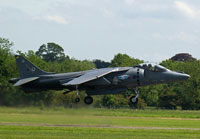
The Harrier GR9 was the last of the
Harrier 'Jump Jets' originating from the 1960s. Capable of taking
off and landing vertically, the Harrier was not tied to airfields
with long concrete runways but, if necessary could be dispersed to
sites in the field close to the forward edge of the battle area.
The RAF Harrier fleet was retired in March 2011
The RAF standardised on the Harrier GR9/9A in a move announced by
the MoD in 2002.
The MoD explained that the optimum development of the JFH was to
support only one Harrier type to its end of service life, the 'more
capable GR 9'.
The JFH received its first upgraded Harrier GR9 from BAE Systems'
Warton facility in November 2005. Under the terms of a £500
programme the avionics of some 60 x Harrier GR 7/7A were upgraded
to GR9 standard and 11 x Harrier T10 will be upgraded to T12
standard.
The GR9 programme which incorporated a major upgrade to the aircraft's
avionics and weapons systems enabled the aircraft to carry a
variety of current and future weapons. These included Maverick
air-surface missiles, Brimstone anti-armour missiles and AIM-9L
Sidewinder air-to-air missiles for self-defence. A new, stronger
composite rear fuselage was also fitted. These aircraft became Harrier GR9s, whilst those with the uprated engines and
weapons systems became Harrier GR9As. The programme also included
an upgrade of the two-seater T10 aircraft to the equivalent GR9
standard known as the Harrier T12.
All three RAF Harrier squadrons were deployed for the 2003 Iraq War
in Operation Telic. And Harriers have been
deployed in Afghanistan in support of ISAF (International Security
Assistance Force) since September 2004. Aircraft operated from
Kandahar airfield.
|
HARRIER
GR7/7A GR9 GR9A T10/T12 Specifications
|
| Crew
(GR7, GR7A, GR9, GR9A)
|
1
|
| Crew
(T10, T12)
|
2
|
| Length (GR7, GR7A,GR9)
|
14.1m
|
| Length (T10, T12)
|
17m
|
| Wingspan (normal)
|
9.2m
|
| Height (GR7)
|
3.45m
|
| Height (T10)
|
4.17m
|
| All
Up Operational Weight |
Approx 13,494kg |
| Max
Weapon Load |
10,000lb/4,500kg |
| Ferry Range
(with 4 x drop tanks) |
5,382km (3,310miles) |
| Max
Speed (at sea level) |
1,065kph (661mph) |
| Engine (GR7, GR9, T10,
T12) |
1 x Rolls-Royce Pegasus Mk 105 |
| Engine
(GR7A, GR9A) |
1 x Rolls-Royce
Pegasus Mk 107 |
| Armament
on seven available wing stations |
2
x 30mm Aden guns |
| |
4
x wing weapon pylons |
| |
1
x under-fuselage weapon pylon |
| |
Conventional
or cluster bombs |
| |
2
x Sidewinder AIM-9L AAM |
| |
ASRAAM |
| |
Up
to 16 x Mk 82 or six Mk 83 bombs |
| |
4 x Maverick air-to-ground
anti-armour missiles |
| |
Paveway II and III laser-guided
bombs |
| |
Brimstone
anti-armour missiles |
| |
CRV-7 rocket
pods |
| |
2 x Storm Shadow
CASOM |
Photo Courtesy of Alasdair Taylor |




