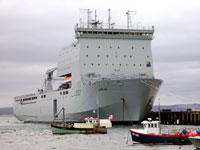
The new ships displace 16,100 tonnes and
replace RFAs Sir Galahad and Sir Tristram. Two ships were ordered in
November 2000 and contracts for two further ships of this class were
placed in November 2001. Compared to their predecessors
they carry more than twice as many vehicles and embarked troops. Using
their stern dock for landing craft and flight deck for helicopters, they
are able to offload in rougher weather twice as quickly.
The design is based on the Dutch LPD Rotterdam and Bay Class vessels are
designed to transport troops, vehicles, ammunition and stores as a
follow-up to an amphibious assault.
Offload is carried out by a flight deck capable of operating heavy
helicopters, an amphibious dock capable of operating one LCU and
mexeflotes which can be hung on the ship's sides. There is no beaching
capability.
The flight deck can accommodate two Merlin or Chinook helicopters, and a
hanger could be fitted in future if required. The ships can carry an
Embarked Military Force of 356 troops and large numbers of vehicles,
although this can be increased to 500 using undesignated space.
In April 2011, the Royal Australian Navy
bought RFA Largs Bay for £65m. Largs Bay was removed from the service of
the UK Navy, as a result of the UK Government's 2010 Strategic Defence
Review.
|
RFA BAY CLASS
Specifications |
| Length |
176.0m |
| Displacement |
16,160 tons full load |
| Speed |
18 knots |
| Range |
8,000nm at 15 knots |
| Complement |
60 plus 356 troops |
| Military Lift |
Space for vehicles
equating to 36 Challenger Main Battle Tanks or 150 light trucks plus
200 tons ammunition |
| Helicopters |
Platform capable of
operating Chinook |
| Armament |
1 x 30mm cannon
CIWS Phalanx |
|
Name |
IN-SERVICE DATE |
| RFA Lyme Bay (L3007) |
2007 |
| RFA Mounts Bay (L3008) |
2007 |
| RFA Cardigan Bay (L3009) |
2008 |
|