|
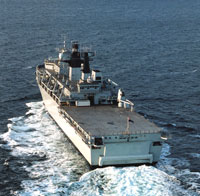
ALBION CLASS (LPD)
LANDING
PLATFORM DOCKS
The contract (worth £449 million) to build
the two LPDs (Landing Platform Docks) was awarded on 18 July 1996 and
first steel was cut 17 November 1997. Each vessel has two helicopter
landing spots and the configuration includes a well dock and stern gate
together with side ramp access. Substantial command and control
facilities are included within a large combined Operations Room and the
vessels are a good fit with the UK governments concept of expeditionary
activities worldwide.
Both vessels are capable of carrying 305 troops, with an overload of a
further 405 for short periods. There is a vehicle deck capacity for up
to 6 x main battle tanks or up to 30 x armoured all-terrain vehicles. In
addition, there is a floodable well dock, with the capacity to take
either four utility landing craft (each capable of carrying a main
battle tank or shelter a hovercraft landing craft. There are 4 x smaller
landing craft on davits, each capable of carrying 35 troops.
HMS Bulwark is also the Royal Navy’s flagship.
| ALBION
CLASS (LPD) Specifications |
| Length |
176m |
| Displacement |
19,560 tons full load |
| Max Speed |
20 knots |
| Range |
8,000nm at 15 knots |
| Complement |
325 |
| Military lift |
305 troops |
| |
67 x support vehicles |
| |
4 x LCU Mk 10 or 2
LCAC (dock) |
| |
4 x LCVP Mk 5 (davits) |
| Armament |
Guns 2-20mm (twin) |
| |
2 x Goalkeeper Close-in
Weapon Systems |
| Helicopters |
Platform for 3 x
Merlin EH 101 |
| |
Chinook capable |
| NAME |
IN-SERVICE
DATE |
| HMS Albion |
2003 (Planned out of
service date 2033) |
| HMS Bulwark |
2004 (Planned out of
service date 2034) |
Photo Copyright BAe Systems
|