|
FLEET HEADQUARTERS
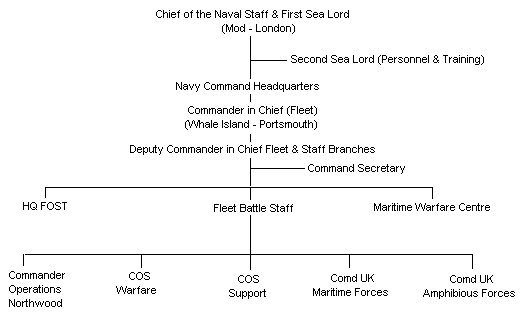
The Fleet Commander (and Deputy Chief of the Naval Staff) has full command of all
deployable UK Fleet units, including the Royal Marines. His responsibilities
include preparation of all aspects of The Fleet for participation in joint and
combined operations with NATO allies including key maritime elements of the
Standing NATO Response Force.
Fleet HQ Portsmouth at Portsmouth has three major roles:
-
The generation of maritime forces to match the operational requirement.
Forces generated have to be manned, equipped and trained to the appropriate
readiness states.
-
Management of the resources provided to the Fleet and the monitoring of
resources and assets thus employed to ensure operational effectiveness and
value for money.
-
The Commander-in-Chief Fleet manages maritime operations by delegating
operational command and control to the Commander Operations (located at
Northwood). Commander Operations has the majority of Fleet units under his
command.

|
|
Fleet Battle Staff
Based in two locations (Portsmouth and Plymouth) the Fleet Battle Staff is
the operational planning departments, capable of planning exercises and
operations for large multinational naval and marine task groups across the
globe. The actual conduct of naval operations is generally the
responsibility of the Joint Forces Command.
Maritime Warfare Centre
The Maritime Warfare Centre provides the repository and focal point for
‘Operational Knowledge Exploitation’. This is the ability to observe and
process every aspect of operational experience to learn lessons from
previous operations and enhance fighting power.
Flag Officer Sea Training
Is the officer responsible for training on all Royal Naval and Royal Fleet
Auxiliary vessels.
Deputy Commander in Chief Fleet
Is the deputy for the Commander and is a member of the Sub Navy Board
Committee. The Deputy Commander directs the staff work of Fleet
Headquarters.
Commander (Operations)
Is the officer who directs all maritime and amphibious forces and associated
operations under the command of the CINCFLEET. In addition he is the
commander of the submarine arm and is the NATO Commander Submarines East
Atlantic and Commander Submarines Allied Naval Forces North.
Chief of Staff (Warfare)
This officer and his staff are responsible for delivering the operational
capability to match the perceived short and longer term requirement.
Chief of Staff (Support)
Is responsible for sustaining the Fleet and ensuring that the required
vessels and units are available for operations. His responsibilities include
personnel administration, the Maritime Warfare Centre, communications
systems, engineering and some aspects of the Fleet Air Arm support.
Commander UK Maritime Forces Commander of the United Kingdom Task Group and
Commander of the Amphibious Task Group
Commander UK Amphibious Forces
Is the Head of Service for the Royal Marines, Commandant General Royal
Marines and commander of 3 Commando Brigade.
The Command Secretary
Is the senior civilian in Fleet Headquarters responsible for civilian
personnel, external accountability, resource management and some aspects of
planning.
Navy Command HQ maintains Waterfront organisations at Devonport, Portsmouth
and Faslane and is responsible for Naval Air Stations at Culdrose, Prestwick
and Yeovilton.
The Chief of Naval Personnel & Training and Second Sea Lord is also based at
Portsmouth
LOGISTIC SUPPORT
In 2000 the three distinct separate service logistic functions were
fused into one and the Defence Logistic Organisation was formed. In a
further amalgamation, from 1 April 2007 the Defence Logistic Organisation (DLO)
and the Defence Procurement Agency (DPA) were merged to form
Defence
Equipment and Support (DE&S).
The DE&S is the organisation that delivers ‘Through Life’ equipment and
logistic support to the Royal Navy, attempting to ensure that the whole
factory to front line process is seamless and properly integrated.
|