|
ALLIED
RAPID REACTION CORPS
The
concept of the Allied Rapid Reaction Corps was initiated by the NATO
Defence Planning Committee in May 1991. The concept called for the
creation of Rapid Reaction Forces to meet the requirements of future
challenges within the alliance. The ARRC provides the Supreme Allied
Commander Europe with a multinational corps sized grouping in which
forward elements can be ready to deploy within 14 days (lead elements
and recce parties at very short notice).
As stated by SHAPE the mission of the ARRC is: “HQ
ARRC, as a High Readiness Force (Land) HQ, is prepared to deploy under
NATO, EU or coalition auspices to a designated area, to undertake
combined and joint operations across the operational spectrum as:
These formations will enable support
crisis support management options or the sustainment of ongoing
operations.”
As NATO's first and most experienced High Readiness Force (Land)
Headquarters the ARRC is actively engaged in the NATO Response Force (NRF)
transformation initiative.
ARRC HEADQUARTERS IN INNSWORTH UK
Currently the ARRC
trains for missions across the spectrum of operations from
deterrence and crisis management to regional conflict.
Currently (2011) Headquarters ARRC is located in Innsworth (UK) with
a peace-time establishment of about 400 personnel. It comprises
staff from all the contributing nations. As the Framework Nation,
the UK provides the infrastructure, administrative support,
communications and 60 per cent of the staff.
HQ ARRC moved from Rheindahlen (Germany) to Innsworth in the UK
during the summer of 2010.
COMMANDER ARRC (COMARRC)
The Commander (COMARRC) and Chief of Staff are UK 3 Star and 2 Star
Generals and the Deputy Commander is an Italian 2 Star General. The
other appointments, as with the training and exercise costs, are shared
among the contributing nations.

OUTLINE COMPOSITION OF THE ARRC
For
operations the ARRC might have some of the following formations under
command:
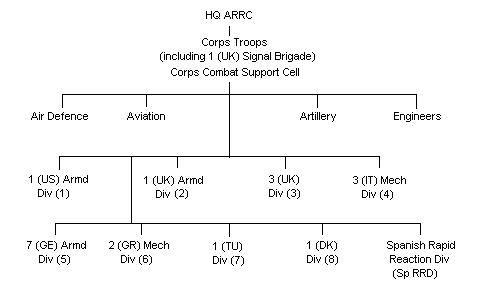
Notes:
(1) United States
(2) Resident in
Germany
(3) Resident in the UK
(4) IT - Italy
(5) GE - Germany
(6) GR -
Greece
(7) TU - Turkish
(8) DK - Danish
The operational organisation, composition
and size of the ARRC would depend on the type of crisis, area of crisis,
its political significance, and the capabilities and availability of lift
assets, the distances to be covered and the infrastructure capabilities of
the nation receiving assistance. It is considered that a four division
ARRC would be the maximum employment structure.
The main British contribution to the ARRC
is 1 (UK) Armoured Division that
is stationed in Germany and there is also a considerable number of British
personnel in both the ARRC Corps HQ and Corps Troops. In addition, in
times of tension 3 (UK) Mechanised Division and 16 Air Assault Brigade
could, if required
move to the operational area to take their place in the ARRC's order of
battle. In total, we believe that if the need arose some 40,000 British
soldiers could be assigned to the ARRC together with substantial numbers
of Regular Army Reservists and formed TA Units.
COMMAND
POSTS AND DEPLOYMENT
Due to the need to be able to respond flexibly to the whole range of
potential operations, HQ ARRC has developed the capability for
rapidly deployable and modular HQs. Deployment begins with the
despatch of a Forward Liaison and Reconnaissance Group (FLRG) within 48
hours of the order to move being given which can then be quickly followed up.
Within
four days the key enablers from 1 (UK) Signal Bde would be within theatre
and three days later HQ ARRC Forward and HQ Rear Support Command (RSC)
Forward – as required - could be established. The forward-deployed HQs
are light, mobile and C-130 transportable. While there is a standard
‘default’ setting for personnel numbers, the actual staff composition is
‘tailored’ to the task and can vary from approximately 50 to 150 staff,
depending on the requirement. The ‘in-theatre’ task would then be
supported by the remainder of the staff, using sophisticated ‘Reachback’
techniques and equipment.
The
Early Entry HQs are capable of sustained independent operations if
required but can also be used as enablers if it is decided to deploy the
full HQ ARRC. This deployment concept has been tested and evaluated on
several exercises and has proven its worth. In parallel, HQ ARRC is
continuously looking to make all of its HQs lighter and more survivable.
|


