|

COMPONENT HEADQUARTERS AT THE TACTICAL LEVEL
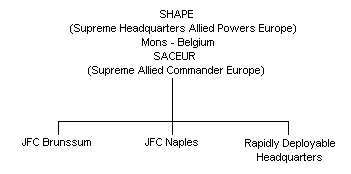
The component or tactical
level will consist of six Joint Force Component Commands (JFCCs), which
will provide service-specific - land, maritime, or air - expertise to the
operational level. Although these component commands will be available for
use in any operation, they will be subordinated to one of the Joint Force
Commanders.
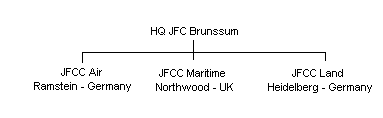
JOINT FORCES COMMAND -
BRUNSSUM
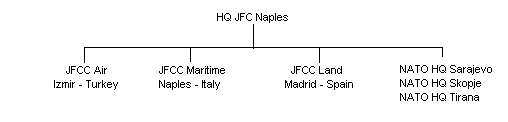
JOINT FORCES COMMAND -
NAPLES
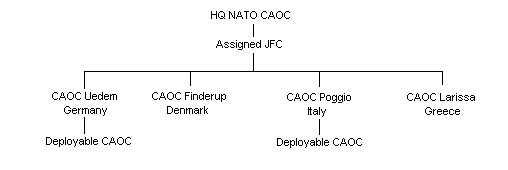
STATIC COMBINED
AIR OPERATIONS CENTRES (CAOC)
In addition to the above component commands there will be four static
Combined Air Operations Centres with two more deployable as follows:
As the deployable CAOCs will
need to exercise their capability to mobilise and deploy, the current
facilities at Torrejon Air Base in Spain will probably be the primary site
for training and exercising in that region.
A small NATO air facility support staff would be stationed at Torrejon to
support this capability.
Deployable Immediate
Reaction Forces (IRF) available:
Immediate Reaction Forces (Maritime) - There are four Maritime
Immediate Reaction Forces that provide NATO with a continuous naval
presence and can be deployed NATO-wide, when required.
ACE (Allied Command Europe) Rapid Reaction Corps (ARRC) - The ARRC
is prepared for deployment throughout Allied Command Europe in order to
augment or reinforce local forces whenever necessary. The Headquarters of
the ARRC are located in Rheindahlen, Germany (2009) and will move to the
UK during the next two years.
Eurocorps HQ – Based around Strasbourg in France
Reaction Forces (Air) Staff – With headquarters at Kalkar in
Germany.
ACE Mobile Force (AMF) – With headquarters at Heidelberg in
Germany.
Deployable National Corps – These deployable corps are available
with headquarters provided by Italy, Turkey, Germany/Netherlands, Spain
and Greece.
NATO Airborne Early Warning Force (NAEWF) - The NATO Airborne Early
Warning Force provides air surveillance and command and control for all
NATO commands. It is based in Geilenkirchen, Germany, and Waddington,
United Kingdom.
NATO Programming Centre (NPC) - The NATO Programming Centre
maintains NATO Air Command and Control Software and provides system
expertise to nations and NATO agencies and headquarters. It is located in
Glons, Belgium.
ALLIED COMMAND
TRANSFORMATION (ACT)
In the
future, Allied Command Transformation, with its headquarters in Norfolk,
US, will oversee the transformation of NATO's military capabilities. In
doing so, it will enhance training, improve capabilities, test and develop
doctrines and conduct experiments to assess new concepts. It will also
facilitate the dissemination and introduction of new concepts and promote
interoperability. There will be an ACT Staff Element in Belgium primarily
for resource and defence planning issues.
ACT commands the Joint Warfare Centre in Norway, a new Joint Force
Training Centre in Poland and the Joint Analysis and Lessons Learned
Centre in Portugal. ACT Headquarters will also supervise the Undersea
Research Centre in La Spezia, Italy and the NATO School at Oberammergau.
There will
be direct linkages between ACT, Alliance schools and NATO agencies, as
well as the US Joint Forces Command. In addition, a number of nationally
or multi-nationally sponsored Centres of Excellence focused on
transformation in specific military fields support ACT.
|