|
In 1963, the three independent service ministries (Admiralty, War Office
and Air Ministry) were merged to form the present MoD.
The UK MoD is the government department that is responsible for all
defence related aspects of UK National Policy. This large organisation,
which directly affects the lives of about half a million servicemen,
reservists and MoD employed civilians, is controlled by The Secretary of
State for Defence.
The Secretary of State for Defence has the following principal deputies;
Minister of State for the Armed Forces.
Minister of State for Defence Personnel, Welfare and Veterans.
Parliamentary Under Secretary of State for Defence Equipment, Support
and Technology.
Parliamentary Under Secretary of State and Minister for Reserves.
Parliamentary Under Secretary of State and the Lords Spokesman on
Defence.
The Secretary of State for defence is assisted by two advisers, one a
civilian and the other a senior military officer:
Permanent Under Secretary of State (PUS):
The PUS is responsible for policy, finance and administration in the
MoD. As the MoD’s Principal Accounting Officer he is personally
responsible to Parliament for the expenditure of all public money voted
to the MoD for Defence purposes. The PUS is the most senior civilian in
the MoD.
Chief of the Defence Staff (CDS): The CDS acts as the
professional head of the Armed Forces and he is the principal military
adviser to both the Secretary of State and to the Government.
Both the PUS and the CDS have deputies; the Second Permanent Under
Secretary of State (2nd PUS), and the Vice Chief of the Defence Staff (VCDS).
The VCDS acts as the Chief Operating Officer in the Armed Forces
Chain-of-Command.
DEFENCE COMMITTEES
In general terms defence is managed through a number of major committees
that provide corporate leadership and strategic direction:
Defence Council - chaired by the Secretary of State for Defence
Defence Board – chaired by the Permanent Secretary
Chiefs of Staff Committee – chaired by the CDS
Service Boards (Admiralty Board, Army Board and Air Force Board)
DEFENCE COUNCIL
The Defence Council is the senior committee which provides the legal
basis for the conduct and administration of defence and this council is
chaired by the Secretary of State for Defence, The Defence Council
reflects the constitutional principle that the defence forces are
commanded by a Member of Parliament. The composition of the Defence
Council is as follows:
Secretary of State for Defence.
Minister of State for the Armed Forces.
Minister of State for Defence Personnel, Welfare and Veterans.
Parliamentary Under Secretary of State for Defence Equipment, Support
and Technology.
Parliamentary Under Secretary of State and Minister for Reserves.
Parliamentary Under Secretary of State and the Lords Spokesman on
Defence.
Permanent Under Secretary of State
Chief of the Defence Staff
Vice Chief of the Defence Staff
Chief of the Naval Staff and First Sea Lord
Chief of the Air Staff
Chief of the General Staff
Chief of Defence Materiel
Chief Scientific Adviser
Director General Finance
Second Permanent Under-Secretary of State for Defence
DEFENCE BOARD
Chaired by the Secretary of State for Defence this board is the MoD’s
main corporate board providing senior leadership and direction to the
implementation of defence policy. It is responsible for the full range
of Defence business other than the conduct of military operations.
The current membership of the Defence Board is:
Secretary of State for Defence
Minister of State for the Armed Forces
Permanent Under Secretary
Chief of the Defence Staff
Vice Chief of the Defence Staff
Chief Executive Defence Equipment and Support
Director General Finance
Audit Committee Chair (Non Executive Director)
Investment Approvals Committee Chair (Non Executive Director)
Appointments Committee Chair (Non Executive Director)
The Mod describes the objectives of the Defence Board’s core tasks as
follows:
-
Role of Defence: To help define and articulate the Department’s
strategic direction, and provide a clear vision and set of values for
defence.
-
Targets and Objectives: To establish the key priorities and Defence
capabilities needed to deliver the strategy.
-
Resource Allocation: To ensure that Defence priorities and tasks are
appropriately resourced.
-
Performance Management: To manage corporate performance and resources
in-year to deliver the required results.
The Defence Board is supported by three
sub-committees:
-
The Defence Audit Committee.
-
The Investment Approvals Committee
-
The People (Personnel) Committee
CHIEFS OF STAFF COMMITTEE
This committee is chaired by the CDS and is the MoD’s senior committee
that allows the CDS to gather information and advice from the single
service chiefs of staff on operational matters and the preparation and
conduct of military operations.
SINGLE SERVICE BOARDS
There are three single service boards: Navy Board, Army Board and the
Air Force Board all of which are chaired by the Secretary of State
for Defence. In general the purpose of the boards is the administration
and monitoring of single service performance. Each of these three boards
has an executive committee chaired by the single service chief of staff;
Navy Board, Executive Committee of the Army Board and the Air Force
Board Standing Committee.

MOD HEAD OFFICE
The MoD Head Office allocates resources to Top Level Budget Holders (TLB)
who are then accountable to the Chief of the Defence Staff and the
Permanent Under Secretary. TLB holders are responsible for the way in
which their resources are allocated.
There are seven TLB holders:
-
MoD Head Office & Corporate Services
-
Land Command
-
Navy Command
-
Air Command
-
Joint Forces Command
-
Defence Equipment & Support
-
Defence Infrastructure Organisation
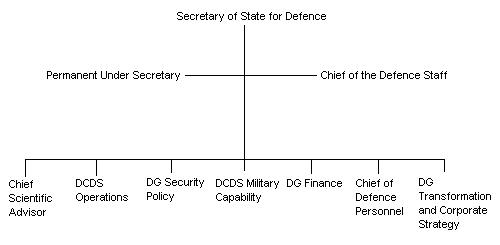
In general terms, the Head Office structure resembles the following:
MOD HEAD OFFICE STRUCTURE
CHIEF OF THE DEFENCE STAFF
The Chief of the Defence Staff (CDS) is the officer responsible to the
Secretary of State for Defence for the coordinated effort of all three
fighting services. He has his own Central Staff Organisation and a Vice
Chief of the Defence Staff who ranks as number four in the services
hierarchy, following the three single service commanders.
The current Chief of the Defence Staff is:
Air Chief Marshal Sir Stuart William
Peach GBE, KCB, ADC, DLO
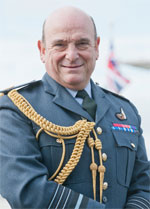
Chief of the Defence Staff Sir Stuart Peach was born in 1956 in the West
Midlands. He was educated at Aldridge Grammar School, the University of
Sheffield (BA), University of Cambridge (MPhil), RAF Staff College and
the Joint Services Command and Staff College (HCSC). He holds two
honorary Doctorates from Kingston University and University of
Sheffield.
Commissioned into the Royal Air Force in 1977, he flew Canberras in the
photographic reconnaissance role prior to three successive tours on
Tornado GR1 in the UK and Germany, qualifying as a weapons and
electronic warfare instructor. He commanded IX (Bomber) Squadron at RAF
Brüggen in Germany 1994-1996. Staff tours include personal staff officer
to the Deputy Commander and Commander-in-Chief in RAF Germany, Executive
Officer to Commander Second Allied Tactical Air Force and Director
Defence Studies Royal Air Force.
Operational service includes Belize, Hong Kong and Germany in the 1980s,
Deputy Commander British Forces in Turkey (Op Warden), UK Head Military
Coordination Centre Zakho (Iraq), Detachment Commander in Saudi Arabia
(Op Jural), Commander British Forces in Italy (Op Engadine), Air
Commander (Forward) in HQ KFOR on Kosovo and Deputy Senior British
Military Adviser in US HQ Central Command 2001-2002.
He commanded the Air Warfare Centre at RAF Waddington from 2000 to 2003,
was Director General Intelligence Collection in the Ministry of Defence
2003-2006 and Chief of Defence Intelligence and Deputy Chairman of the
Joint Intelligence Committee 2006-2009. He held the appointment of Chief
of Joint Operations at PJHQ(UK) from March 2009-December 2011 before
becoming the first Commander of the UK Joint Forces Command from
December 2011-Apr 2013. He was appointed as Vice Chief of Defence Staff
in May 2013. He was appointed as Chief of the Defence Staff on 14 July
2016.
VICE CHIEF OF THE DEFENCE STAFF
Where appropriate the Vice Chief of the
Defence Staff deputizes for the Chief of the Defence Staff. On a day to
day basis he is responsible through the Central Staff for running defence
business (with the Second Permanent Under-Secretary).
|


