|
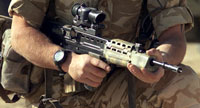
Designed to fire the standard
NATO 5.56mm x 45mm round the SA 80 is fitted with a x4 telescopic (SUSAT)
sight as standard. t 1991/92 prices the total cost of the SA80 contract
was in the order of £384.16 million.
By late 1994 some 10,000 SA 80 Night Sights and 3rd Generation Image
Intensifier Tubes for use with SA80 had been delivered.
The SA 80 had a mixed press and following some severe criticism of the
weapons mechanical reliability the improved SA 80A2 was introduced into
service during late 2001.The total buy for SA 80 was for 332,092 weapons.
Issues
of the weapon are believed to have been made as follows:
|
Royal Navy |
7,864 |
|
Royal Marines |
8,350 |
|
Royal Air Force |
42,221 |
|
MoD Police |
1,878 |
|
Army |
271,779 |
|
|
SA 80A2
Some thirteen changes have been
made to the weapon's breech block, gas regulation, firing-pin, cartridge
extractor, recoil springs, cylinder and gas plug, hammer, magazine and
barrel. Since modification the weapon has been extensively trialled.
In the mean time, before
failure (MTBF) figures from the firing trials for stoppages, following
rounds fired are as follow:
|
|
SA 80A2 |
LSW |
|
UK (temperate) |
31,500 |
16,000 |
|
Brunei (hot/wet) |
31,500 |
9,600 |
|
Kuwait (hot/dry) |
7,875 |
8,728 |
|
Alaska (cold/dry) |
31,500 |
43,200 |
The first SA 80A2 entered operational service during early 2002 and these weapons were in
service across the army by late 2004. The cost of the programme was
£92 million and some 200,000 weapons were modified by the time the
programme ended in May 2006.
The SA80 A2 can be fitted
with the Heckler and Koch 40 mm Underslung Grenade Launcher (UGL) which
is generally issued on the scale of two per infantry section (or one per
four man fire team). This allows an infantry section to lay down HE
fragmentation munitions up 350 m in front of their position. With six
UGL available to an infantry platoon there is a major enhancement to
their operational effectiveness.
During 2013 the UK MoD
issued a request to industry for tenders relating to a 30,000 Modular
Assault Rifle Systems (MARS) with a projected 10 year in-service life.
The tender stated that MARS would be in service with “certain military
units”.
As yet we have no indication of any further progress relating to this
tender. Industry sources suggest that a MARS system could could about
£2,500 per rifle.
|